In comments at a meeting with ambassadors and heads of foreign diplomatic missions and international organizations, held in Tehran on Friday, Iranian Deputy Foreign Minister Majid Takht Ravanchi explained the dimensions of the crimes committed by the United States and the Zionist regime against the Iranian people during 40 days of imposed war.
He described the military aggression by the United States and the Zionist regime as an illegal war and an instance of a war crime against the Iranian people, stating, “The Americans, while the Geneva negotiations were ongoing, for the second time in the midst of diplomatic process, launched a military attack against Iran and martyred the Leader of the Islamic Revolution, a number of commanders and high-ranking officials, and innocent Iranian people.”
Takht Ravanchi described the loss of late Leader of the Islamic Revolution Ayatollah Seyed Ali Khamenei as a very great calamity for Iran, but stressed that the powerful Armed Forces of Iran, with the support and backing of the noble Iranian nation, imposed defeat upon the American and Israeli aggressors and forced the aggressors to change their strategic outlook towards Iran.
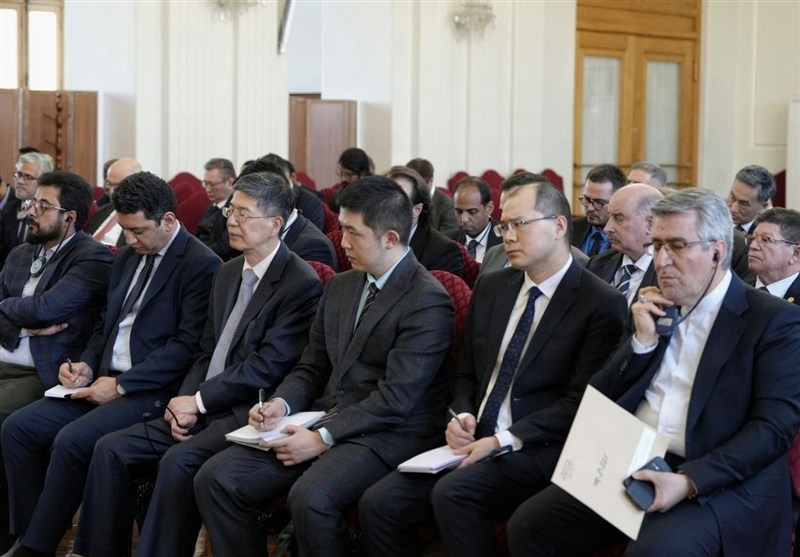
Referring to Iran’s responsible approach regarding the ceasefire declaration and the presentation of the 10-article plan to the Americans, Takht Ravanchi stated, “It has been agreed that Iran’s 10-article plan will be the basis for negotiations.”
“The Islamic Republic of Iran has always welcomed diplomacy and dialogue, but not a dialogue based on false information aimed at deception and paving the way for renewed military aggression against Iran. We do not want a ceasefire that allows the aggressive enemy to rearm and launch another attack, and we have clearly told our friends that this situation will not recur without guarantees,” he underlined.
He further disclosed the objectives of the US and the Zionist regime to dominate the West Asia region and pursue the “Greater Israel” plot, adding, “Iran’s approach to neighboring countries is based on good neighborliness, and Iran’s defensive operations should not be regarded as attacks against these countries, but rather, Iran’s defensive operations targeted American bases and facilities within these countries that were used in the military aggression against Iran.”
Takht Ravanchi thanked the countries that “stood on the right side of history” and condemned the US-Israeli aggression against Iran, and strongly criticized the position of some European countries that, by standing on the wrong side of history, not only failed to condemn the aggressions and crimes against the Iranian people but even supported these aggressions.
The deputy minister emphasized Iran’s right to legitimate self-defense against the aggressors based on the United Nations Charter and international law and norms, declaring, “We fought against two major nuclear powers and a vast global army; we lost great figures; innocent people and innocent children were martyred in the criminal attacks of the aggressors, but the Iranian people resisted, and this resistance is not only for the defense of Iran’s existence but also for defending the interests and benefits of all the countries of the region against the expansionism and warmongering of Israel. The threat of this regime is not limited to Iran but poses a threat to the stability and security of the entire region.”
The US and the Israeli regime launched a large-scale unprovoked military campaign against Iran following the assassination of then Leader of the Islamic Revolution Ayatollah Seyed Ali Khamenei, along with several senior military commanders and civilians on February 28.
In retaliation, Iranian Armed Forces launched attacks on American and Israeli positions in the region, demonstrating their capability to strike back effectively. Despite initial expectations by the attackers of a swift victory, the Iranian response proved significantly more potent, inflicting heavy damage on US and Israeli military resources while rallying the nation's unity and resistance.
While the US president had issued an ultimatum, Pakistani mediation facilitated an agreement for a two-week ceasefire during which negotiations would take place in Islamabad. Iran has proposed a ten-point plan as the foundation for discussions, seeking terms such as the withdrawal of US forces from the region, lifting sanctions, and establishing control over the Strait of Hormuz.
The Supreme National Security Council of Iran emphasized on April 8 that the aggression led to a historic victory for Iran, compelling the US to accept negotiation terms, including a plan for guaranteed non-aggression and the cessation of hostilities.
Iran has stressed that the negotiations would not signify an end to the conflict but rather an extension of the battlefield into diplomatic efforts, with a clear stance of distrust towards the US.