The first reports about the incident, which occurred on October 11, 2026, were published by media outlets in early November (November 8 and 9). European media outlets, as well as notorious Persian-language media outlets, such as Iran International, immediately launched an extensive media campaign over the incident and pointed the finger at Iran and the Islamic Revolution Guards Corps (IRGC) from the outset.
According to the information obtained, a cyberattack allegedly attributed to the IRGC targeted a number of chain stores and food markets in France that used a particular type of refrigeration equipment. The attack reportedly caused refrigerator temperatures to rise from minus 20 degrees Celsius to plus 50 degrees Celsius, resulting not only in food spoilage but also, in some cases, fires at the stores.
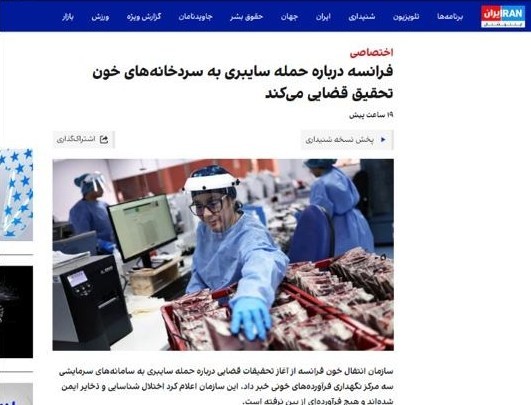
Some media outlets also attempted to portray the incident as extending beyond food stores, exaggerating its scope by including attacks on emergency facilities such as blood banks in their reports. They sought to create the impression that the Islamic Republic of Iran was trying to expand the war into other arenas, such as cyberspace, and into other countries that had apparently remained neutral in the conflict.
Meanwhile, the names of three major brands — Danfoss, Dixell and Copeland — were brought up as the control systems and brains behind the refrigeration systems that had allegedly been targeted by hackers.
This claim was reported by Reuters and several other media outlets, citing France’s cybersecurity agency. According to these reports, the aforementioned systems had been attacked by hackers who had managed to bypass the software layer, take control of the hardware systems of the equipment, and carry out their desired operations to alter refrigerator temperatures.
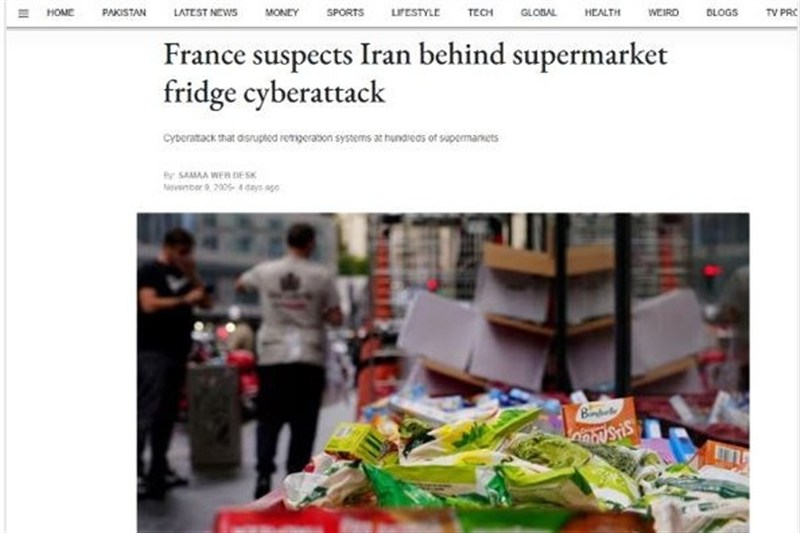
Following the accusation, Iran’s ambassador to France was summoned to the French Foreign Ministry, and the French foreign minister accused the IRGC of carrying out the cyberattack. He also threatened to intensify European sanctions against Iran.
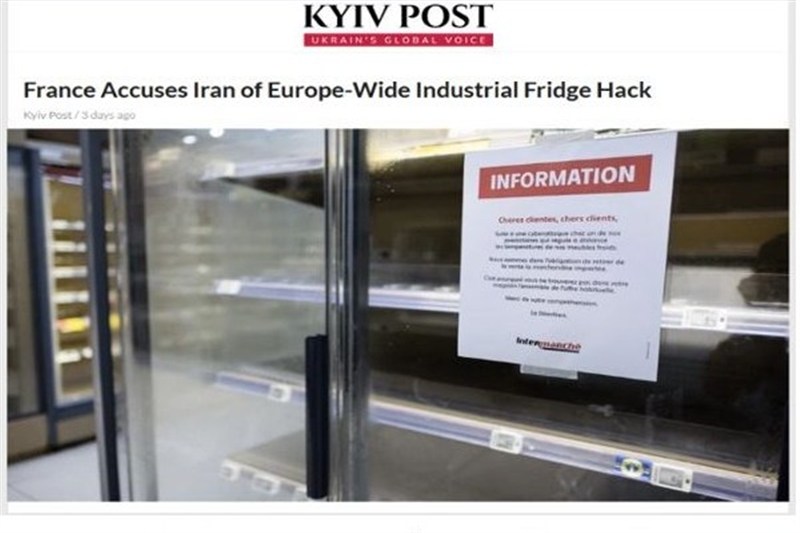
Subsequently, a Ukrainian media outlet initially claimed that other countries, including Spain, Portugal, Poland, Germany and Belgium, had also been affected by the attack.
Examining Conclusive Evidence Refuting France’s Allegation
Based on publicly available technical evidence and official documents, it can be stated with certainty that Iran was not behind this operation. France’s accusation has indefensible technical gaps, and the available evidence indicates that the operation was most likely a joint false-flag action by Ukraine and the Zionist regime. In other words, reports published by Ukrainian media outlets were a clumsy and elementary attempt to level accusations against the Islamic Republic of Iran.
This report first examines the technical gaps in France’s accusation, then presents technical evidence indicating the absence of Iranian involvement. It subsequently addresses the background of the double standards applied to cyberattacks in Europe and claims of responsibility by Russian hacker groups, before analyzing the scenario of a joint false-flag operation.
It also raises the ambiguity surrounding the Israeli company Claroty and its failure to proactively report the vulnerability to French security authorities as a serious question concerning the credibility of France’s official account.
1. Technical Gaps in France’s Accusations
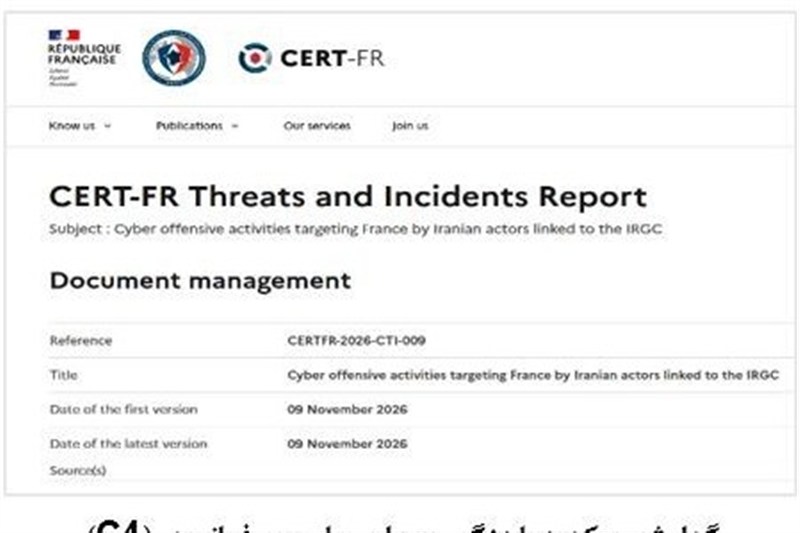
The report by France’s Cyber Crisis Coordination Center (C4) claims that “Persian-language traces” were found in the attack infrastructure and that an Iran-linked propaganda media outlet covered the hacking operation on October 13, two days after the incident, following dozens of other media outlets.
These “pieces of evidence” can only indicate that someone deliberately attempted to fabricate an Iranian footprint. They do not, under any circumstances, prove that the operation was organized and carried out by Iranian state institutions.
In cyberspace, forging Persian characters and using intermediary infrastructure are extremely easy. Propaganda coverage is also merely a “claim of responsibility” and does not, in itself, constitute conclusive evidence.
Furthermore, Claroty’s research report on CVE-2025-41450 had been published before the incident. Danfoss issued a notice in March 2025, and CISA also published a notice in May 2025. This means that these vulnerabilities had been publicly documented long before the incident.
France claims that the infrastructure used in the attack matched infrastructure previously employed to identify other industrial equipment. However, reconnaissance infrastructure, such as specific VPS servers and scanners, can be rented, compromised or shared by multiple entities.
Infrastructure overlap is merely a “clue” at the evidentiary level and cannot serve as a basis for definitive attribution. This is particularly true given that France itself admits that “the initial access method has not been disclosed,” which further diminishes the evidentiary value of its claims.
2. Technical Evidence Regarding the Absence of Iranian Hackers’ Involvement in the Attack
2.1. Outdated Devices Were Widely Exposed to the Internet
The main victims of this attack were Danfoss’s AK-SM 800 and AK-SC 355 series controllers, manufactured by the Danish company Danfoss. These devices are very old, and Danfoss no longer provides security updates for them.
Data from Censys, a cyber infrastructure discovery platform, indicates that before the attack, 61 percent of comprehensive refrigeration control panels (StoreView) worldwide were concentrated in France, and most of them were running a version whose administrator password could be calculated based on the current date.
Directly connecting the management interfaces of industrial equipment controllers to the Internet is itself an architectural-level security flaw that any actor could exploit using a simple scanner. This attack did not require state-level operational capabilities.
This indicates that even the simplest private hackers could have accessed these devices and taken control of them. In this regard, it may be possible to identify traces of actors who are even hostile toward the Islamic Republic of Iran and who could have used this incident to discredit countries such as Iran and Russia. On this basis, there are also indications of the Zionist regime’s involvement.
2.2. Known Vulnerabilities in the Targeted Equipment Had Existed for a Long Time, and Patches Were Ignored
The AK-SM 800A family of devices had three known vulnerabilities:
1. CVE-2025-41450: Authentication bypass
2. CVE-2025-41451: Remote code execution after authentication
3. CVE-2025-41452: Denial-of-service attack after authentication
Danfoss released patches in March 2025 and August 2025, respectively.
This means that the attack involved automated scanning and large-scale exploitation of unpatched Internet of Things (IoT) devices, rather than a targeted state-sponsored operation.
At the Black Hat conference, Claroty, a major Israeli cybersecurity startup, demonstrated how CVE-2025-41450 and CVE-2025-41451 could be chained together and exploited to achieve remote code execution. In other words, this attack technique had been made available to any hacker by this Israeli cybersecurity company long before the incident.
This issue makes the Israeli hackers’ footprint in carrying out the cyberattack even more prominent than before.
It is worth recalling that Claroty is an Israeli cybersecurity company. Given the close relations and security cooperation between France and Israel, a serious question arises as to why Claroty did not report the technical details of this vulnerability and its exploitation chain to French security authorities, such as CERT-FR and ANSSI, before the incident.
Had such a proactive report been made, France could have issued a more targeted warning before the attack occurred and taken vulnerable devices offline.
No indication of such a prior warning can be found in publicly available sources. This point is inconsistent with France’s claim that the attack was attributed accurately and on the basis of full intelligence cooperation. It indicates that France’s official account contains ambiguities in terms of transparency and technical cooperation.
2.3. France Itself Admits That It Does Not Know the Initial Access Route
A technical analysis report by the Cloud Security Alliance explicitly states that the initial access method remains unconfirmed.
Officials have not disclosed whether the attacker exploited a vulnerability, used stolen credentials, relied on default credentials, or gained access through a maintenance service provider.
France’s CERT-FR also stated only in its warning that it was “aware of intrusions affecting a large number of AK-SM and AK-SC series devices” and that “exposing the management interface to the Internet constitutes a violation of security practices.” However, it made no reference to the attacker’s method of entry.
A country that does not know the method of entry cannot point the finger of blame at another country with certainty.
3. Background: Double Standards in Europe’s Response to Cyberattacks
The European Union has been targeted by numerous cyberattacks in recent years that, in terms of scope and severity, have far exceeded the attack on supermarket refrigeration facilities. However, no comparable media or political reaction has followed.
Attacks on energy and industrial infrastructure, long-term cyber espionage against government institutions, and the paralysis of electricity distribution networks are examples of such attacks. Despite their direct damage to the national security of European countries, these incidents have generally remained subject to controlled media coverage.
By contrast, an attack on supermarket refrigeration facilities, which was technically unsophisticated and strategically insignificant, turned into a full-scale media crisis once it became possible to attribute it to Iran.
This disparity in the response indicates a policy of Iranophobia and the instrumental use of cyberattack allegations for political purposes, rather than a response proportionate to the actual severity of the threat.
The extensive media campaign by notorious anti-Iranian outlets such as Iran International also lends credence to the argument that such an accusation is more of a media controversy and propaganda campaign than a claim grounded in scientific and documentary evidence.
4. Cybercrime: Claims of Responsibility by Russian Hacker Groups
Contrary to France’s accusation against Iran, two pro-Russian hacker groups, NoName057(16) and Z-Pentest, claimed responsibility for attacks on refrigeration systems in Europe, including the cold-storage facilities of France’s blood bank.
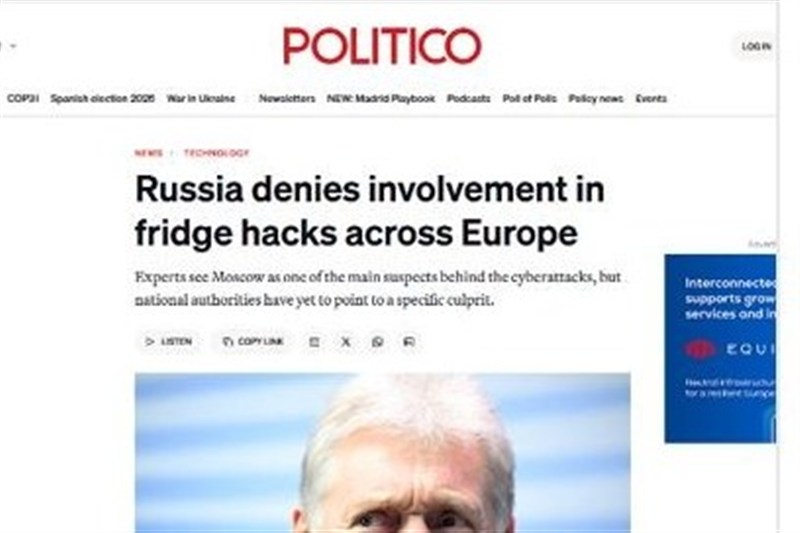
In their Telegram channels, these groups published details, including information about access to Internet-connected Danfoss controllers and Dixell XWEB systems.
The Kremlin, however, described the allegations as “absurd and groundless.”
Although French officials have not confirmed these claims and cybersecurity company Sekoia has assessed the groups’ claims as “unsubstantiated,” the Russian groups’ claims of responsibility and the documentation they published seriously undermine definitive attribution to Iran. They indicate that the case involves, at the very least, other actors as well.
5. Analysis: A Joint False-Flag Operation by Israel and Ukraine
Considering the totality of the evidence, this attack was most likely a joint false-flag operation involving Israel and Ukraine.
Several points can be highlighted in support of this assessment.
5.1. Hacker Groups Attributed to Iran Have No Need for Such a Low-Complexity Operation
The attack on supermarket refrigeration facilities was technically very simple: remotely activating the defrost mode through a web interface and disabling temperature alarms.
Hacker groups attributed to Iran have a record of carrying out far more sophisticated attacks, according to admissions by various cybersecurity companies around the world.
Carrying out a simple attack on refrigeration facilities while leaving behind Persian-language traces and Iranian IP addresses is inconsistent with the technical capabilities of these groups. It looks more like a fabricated footprint planted to misdirect the investigation than the natural traces of a professional operation.
In other words, even if all past and present allegations concerning Iranian hackers were true — something we do not confirm — it would be easy to conclude that Iranian hackers moved beyond this method a long time ago and are currently employing newer and more advanced techniques for their attacks, and not against Europe.
5.2. Ukraine’s Motive for Dragging Russia into the Affair
The Russian hacker groups NoName057(16) and Z-Pentest themselves claimed responsibility for the attacks.
If this operation was designed to discredit both Iran and Russia simultaneously, steering Russian groups toward claiming responsibility could implicate both countries in a single act of sabotage against Europe.
Ukraine has clear interests in simultaneously undermining Russia and Iran in European public opinion and exploiting the situation to advance its objectives.
For this reason, this bankrupt European country, which has lost almost everything in its war with Russia, appears to believe that it can use the current chaos to find a way out of its own predicament and escape the quagmire of an endless war with Russia, while securing greater support from its European partners to confront Moscow.
5.3. Israel’s Motive for Discrediting Iran
Israel is engaged in an extensive cyberwar with Iran and has a record of using cyber tools for psychological operations and sabotage.
Carrying out an attack that leaves an Iranian footprint and then steering public opinion toward attributing it to Iran is consistent with Israel’s strategic objectives of discrediting Iran in Europe in light of the recent war.
A noteworthy point here is that the Zionist regime, which itself has a long history of targeting civilian and urban infrastructure, is seeking to fabricate accusations against the Islamic Republic of Iran, one of the victims of such attacks.
Attacks on fuel supply systems and the prolonged disruption experienced by people waiting in fuel queues are examples of this.
The combination of these two motives — Ukraine’s interest in dragging Russia into the affair and Israel’s interest in isolating Iran — turns this operation into a joint false-flag operation aimed at discrediting Iran and Russia simultaneously in Europe.
[1] https://www.usnews.com/news/world/articles/2026-11-09/exclusive-french-officials-suspect-iran-is-behind-refrigerator-hacks-sources-say#1
https://www.bbc.com/russian/articles/c6rryr74p2w1o#1
[2] https://ir.voanews.com/a/8221595.html
[3] https://www.iranintl.com/202611133854
[4] https://www.usnews.com/news/world/articles/2026-11-09/exclusive-french-officials-suspect-iran-is-behind-refrigerator-hacks-sources-say#1
[5] https://www.samaa.tv/2087359961-france-suspects-iran-behind-supermarket-fridge-cyberattack#1
[6] https://www.kyivpost.com/amp/post/89679#1
[7] https://cert.cyber.gouv.fr/cti/CERTFR-2026-CTI-009/
[8] https://parsi.euronews.com/2026/11/10/french-government-report-cyber-activities-iran-islamic-revolutionary-guard-corps
[9] https://claroty.com/team82/research/freeze-the-controller-defrost-the-food-uncovering-vulnerabilities-in-danfoss-refrigeration-controllers
[10] https://www.danfoss.com/en/service-and-support/coordinated-vulnerability-disclosure/danfoss-security-advisories/dsa-2025-03-01?trk=public_post_comment-text
[11] https://www.cisa.gov/news-events/ics-advisories/icsa-25-140-03
[12] https://www.danfoss.com/en/service-and-support/coordinated-vulnerability-disclosure/danfoss-security-advisories/
[13] https://www.danfoss.com/en/service-and-support/coordinated-vulnerability-disclosure/danfoss-security-advisories/dsa-2025-03-01
[14] https://claroty.com/team82/research/freeze-the-controller-defrost-the-food-uncovering-vulnerabilities-in-danfoss-refrigeration-controllers
[15] https://labs.cloudsecurityalliance.org/wp-content/uploads/2026/10/CSA_research_note_danfoss_controller_french_retail_sabotage_20261013-csa-styled.pdf
[16] https://labs.cloudsecurityalliance.org/research/csa-research-note-refrigeration-ot-correlated-risk-20261103/
[17] https://cert.cyber.gouv.fr/alerte/CERTFR-2026-ALE-012/
[18] https://cisoclub.ru/russkojazychnye-hakery-vzjali-otvetstvennost-za-ataki-na-holodilniki-evropejskih-supermarketov/
[19] https://www.dr.dk/verificerer/pro-russiske-hackergrupper-tager-ansvaret-omfattende-hacking-af-koeleskabe-og-koelediske
[20] https://www.politico.eu/article/russia-denies-involvement-in-fridge-hacks-across-europe/